You will hear these words within an hour of landing in Amsterdam. Some are about food, some are about money, and one decides whether you tip.
We are Amsterdam locals running tours since 2015. Here is what each word means, how to use it, and the story behind it, because most of them have one.
Gezellig
The word you will hear most, and the hardest to put into one English word.
It comes from gezel, an old Dutch word for companion. Dutch dictionaries use it for anything socially pleasant or cosy: an evening, a person, a room.
Otto explains it best through tipping. If a waiter or a guide “smiled and really made you feel comfortable, you’re like, you know what, that was gezellig. Thank you for the pleasant experience.” Then you leave a little something.
Say it on your way out and watch the waiter smile.
Lekker
Tasty. Say it about anything you eat and like. “If you think it’s tasty, you say lekker.”
Short, easy to say, and you will need it all day.
Proost
Cheers. “If you want to say cheers, you say proost!” Glass up.
Going Dutch
Splitting the bill, each person paying their own share, down to the cent.
Otto’s version: “We’re just good with money. Very good with money.” So good that the Dutch have Tikkie, a payment request you send a friend after a shared bill, “for as much as 50 euro cents.”
Don’t be offended when it happens. It is not stingy, it is precise.
Funny thing: the phrase is not Dutch at all. “Dutch treat”, everyone pays their own share, first shows up in American newspapers around 1870, and “going Dutch” follows by about 1900. Nobody agrees on why it says Dutch. The popular story about old English and Dutch wars does not fit the dates.
Peperduur
Very expensive. Literally “as expensive as pepper”.
Dutch dictionaries say the word recalls a time when pepper was so costly that peppercorns were even used as money. It was first written down around 1800.
Otto’s modern example: a small apartment in Amsterdam. Peperduur.
Hagelslag
Chocolate sprinkles. On buttered bread. For breakfast. Yes, adults too.
Hagel is hail and slag is the striking, so the name reads as “hail shower”. The first version, from 1908, had no chocolate in it at all: white aniseed sprinkles from a firm on the Lindengracht here in Amsterdam. Chocolate arrived in 1913.
The butter goes on first. It is the glue.
Want the full Dutch breakfast? Our Dutch breakfast guide covers it.
Beschuit met muisjes
A round rusk with butter and sugared aniseed on top, blue for a baby boy and pink for a girl. “Muisjes” means little mice.
It is family of hagelslag: the first hagelslag was aniseed too, so the sprinkles on your breakfast and the baby sprinkles are two branches of the same story.
Jenever (genever)
The Dutch grain spirit, and the reason the English have gin. Genever is first written down as a drink in Dutch in 1606. English borrowed it as “geneva” in 1706 and cut it down to “gin” by 1714.
The trick question at the bar: oude (old) and jonge (young) jenever have nothing to do with age. They describe the recipe. Old has more than 15% malt wine, the whisky-like grain base. Young has at most 15%, so it tastes closer to plain gin.
How to drink it: the glass comes filled to the brim. Bend down and take the first sip without lifting it. Somebody always spills anyway.
A kopstootje is that glass of jenever with a beer next to it. Not the same thing as the bend-down sip, whatever the bartender tells you.
You may hear that “Dutch courage” comes from English soldiers drinking jenever before battle. Nice story. The earliest print of the phrase is 1814, and it belongs to a family of English insults about the Dutch.
Where to drink it: our spirits and street food crawl.
Bitterballen
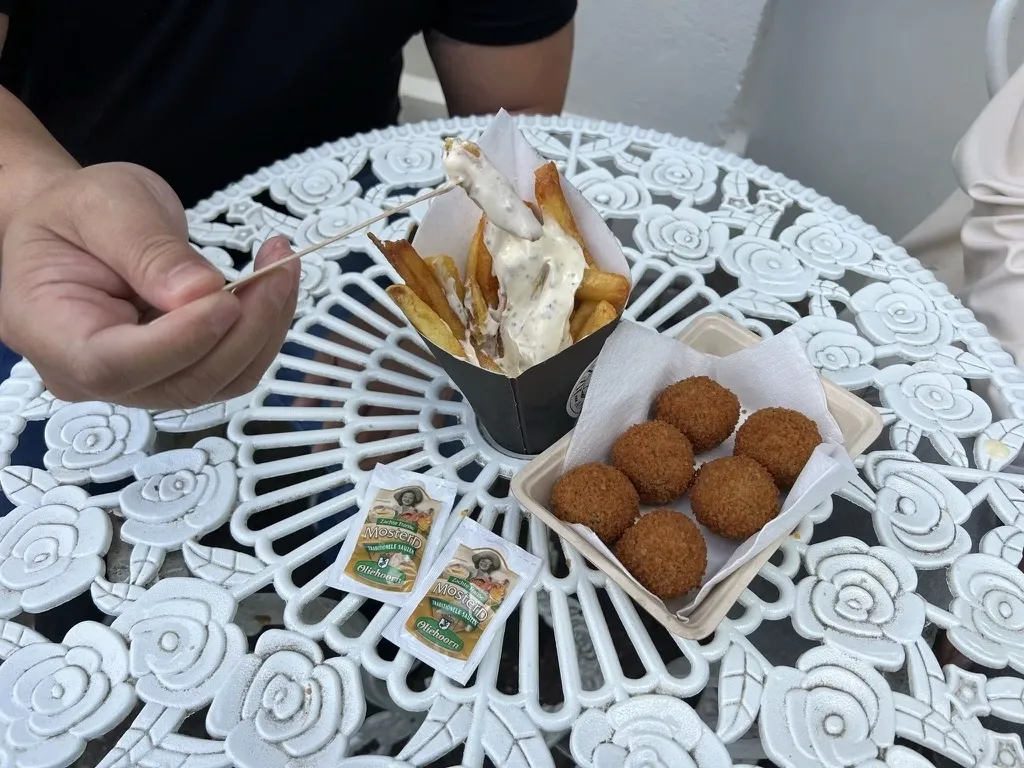
Small deep-fried balls, eaten off a cocktail stick with mustard, in one bite. They are not bitter.
The name comes from the glass. A “bittertje” was a small glass of gin with bitter herbs, drunk before dinner, and the ball was what you ate with it. It first shows up in an Amsterdam newspaper on 17 February 1923.
Warning: molten in the middle. Bite carefully.
More fried things to try: the best Dutch snacks in Amsterdam.
Stroopwafel
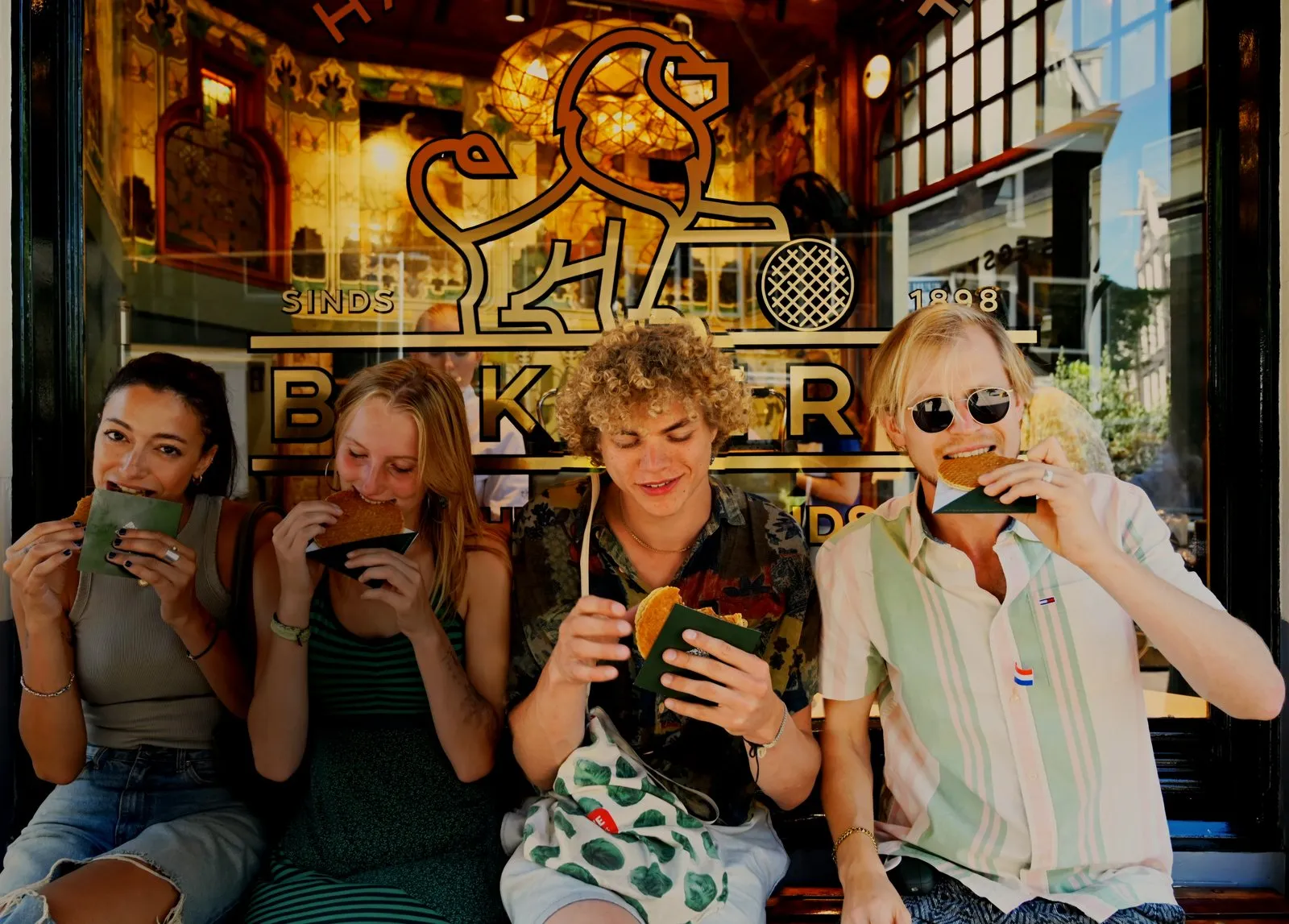
“Syrup waffle”. Two thin halves with syrup in between. The waffle is baked as one disc and split while it is still hot, because a cold one shatters.
Eat it warm, while the syrup still moves.
Haring and Hollandse Nieuwe
Haring is herring. Hollandse Nieuwe is the new catch: caught from 1 May to 31 August, it keeps the name until 30 September, and it needs at least 16% fat. By law it is frozen for at least 24 hours first.
The Dutch saying is not “a herring a day”. It is “Haring in ‘t land, de dokter aan kant”: herring in the country, doctor pushed aside. It was printed in 1835.
Kibbeling
Battered, fried bites of white fish from the fish stall. The word is from 1648 and comes from an old word for a fish’s gill and jaw. For centuries kibbeling meant exactly that: the cheeks and jaws of a cod.
Patat or friet
Fries. North of the big rivers people say patat, south of them friet. A dialect researcher mapped that line in 1972, and a journalist checked 169 menus in 2024. The line is still there.
Order a “frietje met” (or “patatje met”) and you get fries with sauce.
Frikandel speciaal
A skinless deep-fried sausage, sold since 1954, split and filled with mayonnaise, curry ketchup and chopped raw onion. The Dutch make about 600 million a year.
Oude kaas
Old cheese. Found something crunchy in it? Not salt, not sugar. Those are crystals of tyrosine, an amino acid, and they show up as the cheese ages.
Drop
Dutch liquorice. The “salty” kind is not salty: the taste is salmiak, ammonium chloride. Double salt drop has about 8% of it.
Otto’s advice: you need to learn to love it.
Pindakaas
Peanut butter, but the word says “peanut cheese”. Two reasons. In Suriname, a pressed block of peanuts was sliced like cheese, and a German missionary wrote it down as “Pinda-Käse” in 1783. And when Calvé launched the spread in the Netherlands in 1948, the word “boter” (butter) was reserved for dairy. So: pindakaas.
Appeltaart
Dutch apple pie: tall, dense with apple and cinnamon, in a thick crust. The whipped cream on the side is unsweetened, because the pie is sweet enough.
Hear them all in one afternoon
On the 10 Tastes of Amsterdam tour you will say lekker about ten times and proost at least twice. 3 hours on foot through the canal ring and the Jordaan, 10+ tastings, small groups of max 12, with a local guide who explains the words as you eat them.
Amsterdam’s #1-rated food tour, Tripadvisor Travellers’ Choice Best of the Best 2026, awarded to the top 1% of experiences worldwide. 5,000+ five-star reviews.